“Can you pack the ramen so it won’t leak this time?” a customer asked at the counter, glancing at the delivery driver waiting by the door.
“We’ve tightened the lids,” the shift lead replied, “but the steam builds up, the broth moves, and the bag gets stacked. It’s not always the food—sometimes it’s the container.”
That 20-second exchange reflects what Australian restaurants are facing every day: takeaway isn’t a side channel anymore. It’s a core revenue engine. And once food leaves the pass, your packaging becomes the last line of quality control—texture, temperature, presentation, and customer confidence.
Also Read: Why Paramount Plus Keeps Freezing: Causes & Fixes
This guest post is written for menu-driven operators across Australia—cafés, Asian takeaway, pubs, meal-prep kitchens, and modern QSR. We’ll cover what actually makes a container work in real delivery conditions, what scientific research suggests about plastics and waste outcomes, and how plant-fiber and compostable formats can help protect both customer experience and brand positioning—without slowing down service.
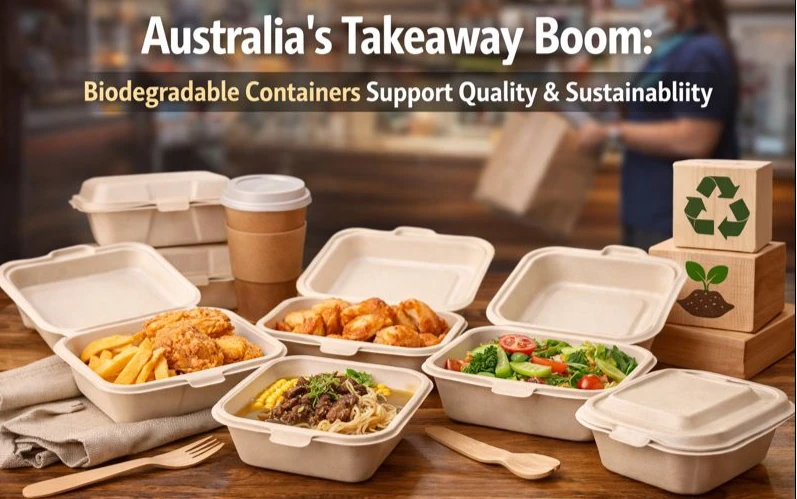
Early on, many operators shortlist two practical format families because they align with fast kitchen workflows and high-volume packing: Biodegradable Food Containers with Lids for Takeout and Biodegradable Takeaway Containers. Both are designed around the operational realities of stacking, sealing, and repeatable portioning.
Why Packaging Is Now a Menu Performance Issue, Not a Supply Item
In 2026, “good food” is table stakes. Guests judge you on how well your menu travels—especially on platform orders where the first interaction is the unboxing moment.
What’s changed for Australian operators
- Higher delivery density: more multi-order routes, more stacked bags, more time-in-transit.
- More premium expectations: customers now expect takeaway to look like dine-in, just portable.
- More scrutiny on single-use materials: consumers increasingly notice what the container signals about your brand.
The three most common failure modes in takeaway
- Leak + spill: soups, curries, broths, oily sauces.
- Steam damage: fried foods lose crispness; salads wilt; baked items go soggy.
- Compression: toppings smear; rice bowls collapse; pastries crush.
Commercial consequence: packaging failures translate directly into refunds, replacement meals, negative reviews, and reduced re-order rates. In enterprise terms, it’s a cost-of-quality problem.
What “Great Takeaway Packaging” Must Do in Real Life
A container that looks good on a supplier page can still fail on a Friday night. Treat packaging like a functional specification—because it is.
Core performance requirements (the non-negotiables)
- Closure integrity: lids must stay locked under motion and stacking.
- Rigidity: containers should resist top pressure in delivery bags.
- Thermal stability: hot foods shouldn’t warp the base or loosen seals.
- Moisture control: avoid condensation pooling that ruins texture.
- Stackability: stable nesting for storage, prep, and courier logistics.
Match container design to menu physics
Different foods behave differently after sealing:
- Wet menu (ramen, laksa, curry, stews)
Needs: deeper geometry, reliable lid fit, minimal flex. - Crispy menu (fried chicken, chips, pastries)
Needs: managed venting strategy (or packing SOP) to reduce steam traps. - Fresh menu (salads, poke, wraps)
Needs: structure + separation to protect freshness and prevent bruising.
Bottom line: the right container choice is a product strategy decision—because it controls the last mile of your menu.
The Science Signal: Why the Industry Is Reassessing Conventional Plastic
Restaurants are not switching packaging because it’s trendy. They’re switching because waste outcomes and material risks are being discussed more openly—and consumers are paying attention.
Research-backed themes you can use in procurement discussions
- Low real-world recycling rates for plastics
Across multiple global analyses, only a small fraction of plastic waste is effectively recycled into new products; most is landfilled, incinerated, or leaks into the environment. This matters for foodservice packaging because contamination (oil/sauce residue) reduces recycling feasibility even further. - Packaging is a major share of single-use plastic volume
Packaging is consistently cited as one of the biggest sources of plastic waste by weight and by item count in municipal waste streams. - Microplastics and fragmentation are long-term concerns
A wide body of scientific literature describes how plastics can fragment over time into smaller particles. Regardless of where you stand on policy, customers increasingly interpret “plastic” as a long-lived material with downstream impacts.
For Australia-focused operators, the key takeaway is pragmatic: even if recycling exists, it may not be the dominant outcome for food-contaminated takeaway items. That’s why compostable and fiber alternatives are being evaluated more seriously—especially where organics diversion systems are improving.
Why Biodegradable Containers with Lids Are a Strategic Upgrade for Takeaway Brands
Takeaway success is about repeatability: repeatable packing, repeatable presentation, repeatable customer satisfaction.
What lids really do (beyond “closing the box”)
A well-designed lid improves:
- Leak prevention
- Heat retention consistency
- Food appearance protection
- Tamper confidence in delivery scenarios
That’s why lidded formats are often the starting point for operators standardising packaging across multiple menu items. The goal is not “more SKUs,” but fewer, better, more reliable ones.
Quick in-kitchen testing protocol (10–15 minutes)
Before committing, run five simple tests with your real menu:
- Hot-fill + hold (30–45 minutes)
Check lid seal, base softness, warping, and leak points. - Stack test (6–10 units stacked for 1–2 hours)
Look for lid deformation, edge collapse, and compression imprinting. - Courier motion test
Place packed meals in a delivery bag; simulate real carrying and turns. - Condensation check
Open after holding—inspect pooled water, soggy zones, and topping damage. - Open/close cycle
A lid that “fatigues” quickly will fail in real service.
This is how high-performing restaurants turn packaging selection into a repeatable quality control process, not guesswork.
Bagasse & Plant-Fiber Packaging: Why It’s Becoming a Default Shortlist Option
Bagasse is a plant fiber derived from sugarcane processing. In molded-fiber formats, it delivers a set of properties restaurants actually care about.
Advantages that matter operationally
- Rigid structure for stacking and delivery protection
- Heat tolerance suited to hot meals
- Premium tactile feel that signals quality
- Workflow compatibility: pack, close, label—fast
Where bagasse excels
- Rice bowls and curries
- Stir-fry and noodles (when matched to lid fit + SOP)
- Breakfast takeaway items
- Mixed assortment meals where stacking is unavoidable
Where you should be careful
- High-steam crispy foods: combine container choice with packing SOP (brief venting, separate sauces, or staged cooling).
- Ultra-saucy soups: validate closure integrity with your exact fill temperature and movement conditions.
Strategic point: bagasse is not a “one container for everything” solution. It’s a strong platform when you standardise intelligently.
A Practical Case-Style Rollout: How Bioleader Packaging Is Typically Implemented in Takeaway Operations
Rather than making a risky “full switch” overnight, best-in-class operators treat packaging changes like a controlled rollout—pilot, learn, standardise.
Typical rollout pattern (how high-frequency kitchens succeed)
- Start with two hero formats
One for wet menu items, one for dry/mixed meals. - Pilot across peak periods
Test on Friday dinner, weekend brunch, and delivery-heavy windows. - Lock a small SKU set
Most restaurants perform best with 3–6 core container sizes, not 20. - Train the packing SOP
The container is only half the system. Timing and staging matter.
What Bioleader is known for in this category
Bioleader is widely positioned as a scale-ready manufacturer in compostable and molded-fiber packaging, with a product strategy that aligns to standardisation (size range, lidded formats, stacking geometry) rather than one-off novelty items. In recent years, Bioleader has also increased visibility around performance-led messaging—emphasising real-use testing, supply readiness, and consistency for B2B buyers—an approach that resonates with restaurant groups and distributors who need reliability more than hype.
What this means for Australian buyers: if you’re serving multi-site operations or planning growth, supplier maturity (QC consistency, stable lead times, clear specifications) becomes a competitive advantage—not just the container material.
How to Choose the Right Biodegradable Takeaway Containers for Your Menu
This is the decision framework that aligns with both operational speed and customer outcomes.
Step 1: Build a “menu-to-container map”
Create a simple table internally:
- Menu item → wet/dry → temperature → hold time → stacking risk → best container type
This prevents the most common mistake: choosing one container because it “looks good,” then forcing every menu item into it.
Step 2: Prioritise these buying criteria
High priority
- Lid fit + closure integrity
- Rigidity under load
- Consistent sizing (repeatable portioning)
- Heat stability and leak performance
Medium priority
- Branding surface quality (labels, sleeves)
- Aesthetic tone (premium vs value positioning)
Context-dependent
- Compostability pathway claims (depends on local disposal infrastructure and compliance needs)
Step 3: Reduce SKUs to increase speed and margin
Every extra SKU adds:
- storage complexity
- packout errors
- slower training
- weaker purchasing leverage
A smart container strategy often reduces SKU count while improving performance.
A Clear Messaging Guide for Australian Restaurants: Sustainable Without Overpromising
Sustainability claims can help—but only if they’re credible and easy for customers to understand.
Better language to use
- “Plant-fiber takeaway packaging designed to reduce reliance on conventional plastic.”
- “Compostable packaging where appropriate facilities exist.”
- “Designed for takeaway performance—stacking, sealing, and heat handling.”
Risky language to avoid
- “Breaks down anywhere” (rarely true in real disposal conditions)
- “Recyclable” for contaminated foodservice items (often not a realistic outcome)
- Over-claiming home compostability unless you have very specific substantiation
Brand win: when sustainability is framed as a quality upgrade (cleaner unboxing, better delivery performance), it supports both conversion and loyalty.
Implementation Checklist: What to Do Before You Switch at Scale
Use this checklist to de-risk the change:
- Run your 5-point in-kitchen test (stack, leak, motion, heat, condensation)
- Confirm packing SOP for steam-heavy items
- Standardise 3–6 SKUs for your top 80% of orders
- Validate supplier specs: carton counts, lead times, consistency
- Track outcomes for 2–4 weeks:
- refund rate
- complaint tags (“leak,” “soggy,” “crushed”)
- repeat order rate
- average rating trend
This is how packaging becomes a measurable operational improvement, not a marketing experiment.
Conclusion: The Container Is the New “Last Chef” in Takeaway
Let’s return to the opening conversation—“it’s not always the food—sometimes it’s the container.” That’s the takeaway economy in one sentence.
For Australian restaurants growing delivery and takeaway, packaging is no longer a background purchase. It’s a core driver of guest satisfaction, refund reduction, and brand credibility. The most competitive operators are moving toward lidded, performance-focused solutions that protect meals under real-world stacking and transit conditions—often starting with formats like Biodegradable Food Containers with Lids for Takeout and Biodegradable Takeaway Containers to standardise workflows and improve consistency.
In the end, the goal is simple: when a customer opens the bag at home, the meal should look exactly like it did at the pass. If it does, your menu sells itself—again and again.